Centralize Your Entire Leasing Process
All-in-One Leasing Platform: Manage everything from listing syndication to signed leases in one seamless platformCentralized leasing is a model where one team handles leasing for multiple properties from a single hub, replacing the traditional setup of on-site agents at each building. For multifamily operators managing portfolios across several locations, it cuts redundant roles, speeds up response times, and creates a consistent renter experience across every property.
The term “central leasing” is often used interchangeably with “centralized leasing.” Both describe the same operational shift: moving leasing activity away from individual properties and into a shared team that serves the entire portfolio.
Why operators are centralising now
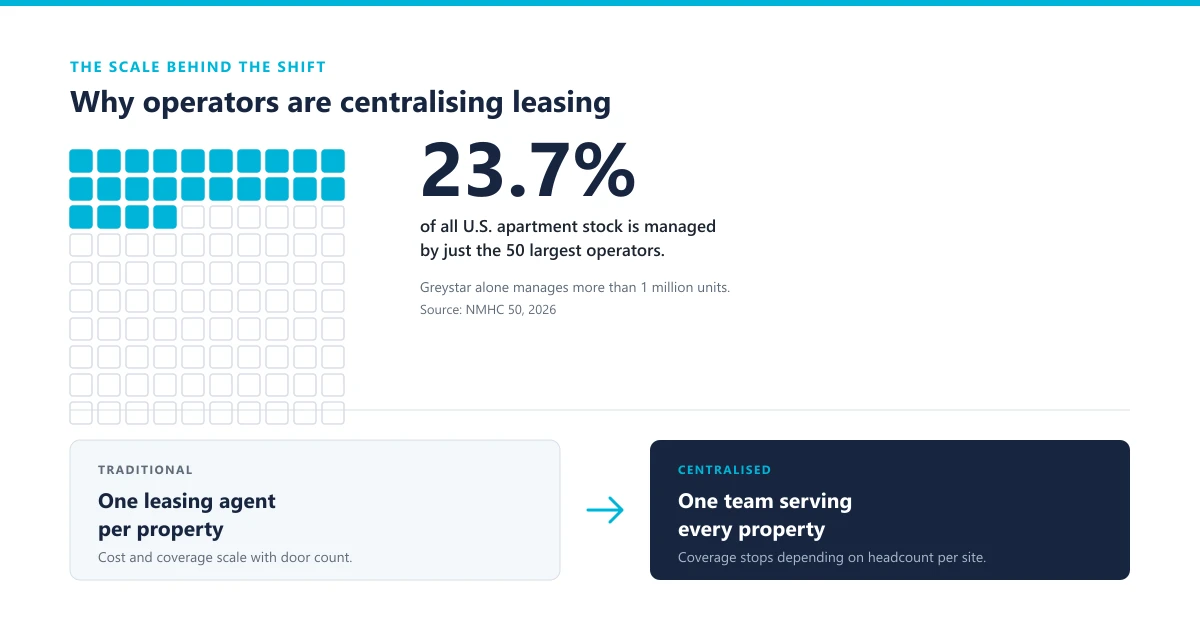
The economics of on-site leasing are getting harder to justify. According to the 2026 NMHC 50, the 50 largest apartment managers in the U.S. oversee 23.7% of the nation’s apartment stock, with Greystar alone managing more than 1 million units. At that scale, the pressure to reduce per-unit operating costs pushes operators toward shared-services models. Centralisation is one of the highest-impact moves available because leasing is both labour-intensive and repetitive across properties.
At the NAA Apartmentalize 2024 session “Democratizing Centralization for Large and Small Firms”, panellists from Bozzuto, Veritas Investments, and Canopy Analytics concluded that centralisation is not only possible for any firm regardless of size, but vital to its success. David Thomas, Director of Innovations at Veritas Investments, noted that operators who centralise can “cross-reference properties to find [prospects] the right home” rather than losing leads to competitors when a single community does not fit.
Accelerate Your Decision-Making Process
AI-Powered Tenant Analysis: Make informed decisions in minutes, not hours, with our AI-driven tenant data analysisWhat centralised leasing actually looks like
In a centralised model, prospective renters interact with a leasing hub rather than an on-site agent. The hub handles:
- Inquiry response — phone, chat, and email inquiries answered from one team, often with AI-assisted tools that maintain a 100% response rate
- Tour scheduling — self-guided or virtual tours coordinated centrally, with automated confirmations and reminders to reduce no-shows
- Application processing — tenant screening run through a single pipeline with consistent criteria across all properties
- Lease execution — digital lease generation and eSignature from one platform
The on-site team’s role shifts from leasing to resident experience: handling move-ins, maintenance coordination, and renewals. As Lucretia Kumah, SVP at Bozzuto, described at the NAA session, this lets staff focus on “improving the living experience and retaining residents” rather than chasing new leads.
Who centralised leasing is for
Centralised leasing works best for operators with scale and geographic spread. Portfolios that benefit most tend to share three characteristics:
- Multiple communities under one owner or manager — centralisation creates value when there are at least 3 to 5 properties to consolidate, because the shared team needs enough lead volume to justify dedicated staffing
- High lead volume relative to on-site capacity — if on-site agents are missing calls or taking more than 24 hours to respond, a central team absorbs the overflow
- Inconsistent leasing experience across properties — if each site runs its own process, centralisation standardises everything from screening criteria to lease terms
Operators with a single property or very small portfolios (under 50 units) typically find that the overhead of building a centralised team outweighs the efficiency gains.
How to implement centralised leasing without losing the personal touch
The most common objection operators raise is that renters want a local, personal experience. The NAA session panellists reported the opposite: renters want fast, consistent answers, regardless of who provides them. Veritas Investments found that when they showed prospects eight properties, the prospect rarely selected the initial one they inquired about, proving that a centralised team with cross-portfolio knowledge actually serves prospects better than a single-site agent.
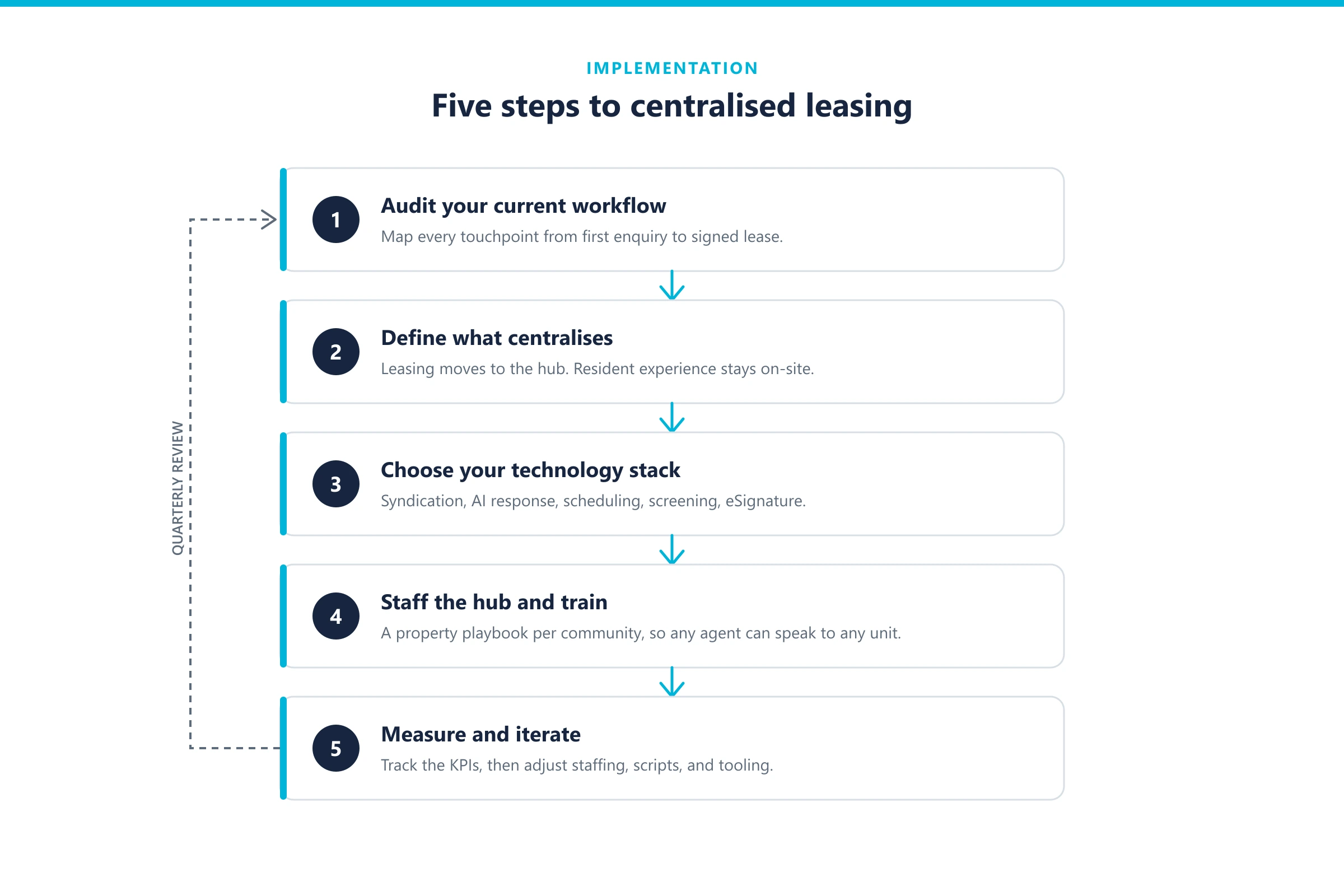
Step 1: Audit your current leasing workflow
Map every touchpoint from first inquiry to signed lease at each property. Identify where leads drop off, where response times lag, and where the process varies between sites.
Step 2: Define what stays on-site vs. what centralises
Leasing activity centralises (inquiry response, tour scheduling, applications, screening). Resident-facing activity stays on-site (move-in, maintenance, renewals). The line is clearer than most operators expect.
Step 3: Choose your technology stack
A centralised model requires a platform that unifies listings, leads, communications, and applications in one place. The most effective setups include:
- Listing syndication to marketplaces, so all properties publish from one dashboard
- AI-powered inquiry response, to maintain 100% response rate across the portfolio
- Automated tour scheduling with confirmation and reminder workflows
- Integrated tenant screening with consistent criteria across all properties
- Digital lease generation and eSignature
Step 4: Staff the hub and train on portfolio-wide SOP
The central team needs to know every property’s unique selling points, pricing, and policies. Create a property playbook for each community so agents can speak knowledgeably about any unit in the portfolio.
Step 5: Measure and iterate
Track the metrics that matter (see the measurement section below) and adjust staffing, scripts, and technology quarterly.
Measuring centralised leasing performance
The metrics below reflect standard leasing KPIs tracked by multifamily operators. This framework draws from benchmarks published in the NMHC research library and operational data discussed at NAA Apartmentalize 2024, where panellists reported that centralised operations drove delinquencies down by as much as 11% and pushed retention rates to around 62%, well above the industry average.
Metric | What it measures | Why it matters for centralised teams |
Lead-to-tour rate | % of inquiries that convert to scheduled tours | Centralised teams should outperform on-site agents here because they respond faster and can cross-sell across properties |
Tour-to-application rate | % of tours that result in a submitted application | Self-guided and virtual tours coordinated centrally can increase this by reducing scheduling friction |
Application-to-lease rate | % of applications that convert to signed leases | Consistent screening criteria across properties reduces drop-off from inconsistent standards |
Average response time | Minutes from first inquiry to first response | The single most important metric. AI-assisted teams can hit under 1 minute; manual teams should target under 5 minutes |
Cost per lease | Total leasing cost divided by leases signed | Centralisation should reduce this by eliminating redundant roles across properties |
Lease-up velocity | Days from listing to signed lease per unit | Track trend over time; centralised teams with syndication typically show faster lease-up |
Retention rate | % of residents who renew their lease | NAA data shows centralised operations reaching 62% retention, above the industry average |
Centralised leasing in practice
Tricap Residential Group (industry case)
Tricap Residential Group, a Canadian multifamily operator, centralised their leasing operations across their portfolio using virtual tours and a shared leasing team. Their published case study describes a model built around video, so prospects kept a personal point of contact while the company reduced the overhead of staffing leasing agents at every property. The key: Tricap paired centralisation with technology rather than simply removing on-site staff.
Aquilini Investment Group (Leasey.AI client)
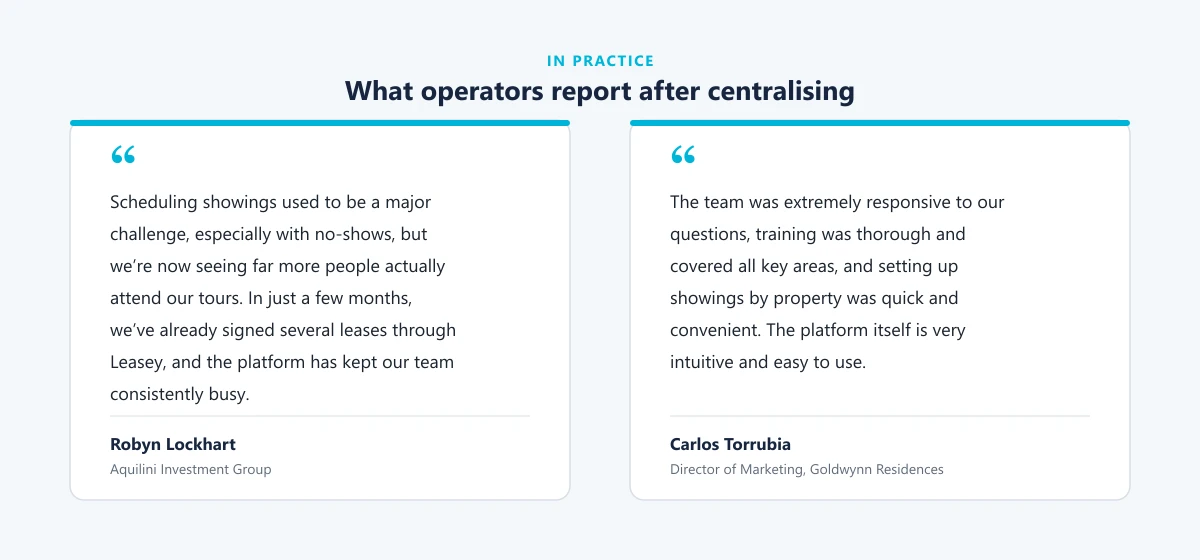
Aquilini Investment Group, one of Western Canada’s largest private investment groups, adopted Leasey.AI to centralise their leasing workflow. Robyn Lockhart from Aquilini reported:
“Leasey has made a big difference for our leasing process. Scheduling showings used to be a major challenge, especially with no-shows, but we’re now seeing far more people actually attend our tours. In just a few months, we’ve already signed several leases through Leasey, and the platform has kept our team consistently busy. Overall, we’ve seen huge improvements on our leasing flow.”
Robyn Lockhart, Aquilini Investment Group
This is particularly significant because Aquilini operates at institutional scale, the same segment where centralisation delivers the most value.
Goldwynn Residences (Leasey.AI client)
Goldwynn Residences, a multifamily operator, centralised their leasing operations through Leasey.AI. Carlos Torrubia, Director of Marketing at Goldwynn, noted:
“The team was extremely responsive to our questions, training was thorough and covered all key areas, and setting up showings by property was quick and convenient. The platform itself is very intuitive and easy to use.”
Carlos Torrubia, Director of Marketing, Goldwynn Residences
Goldwynn’s experience highlights a critical success factor for centralisation: onboarding speed. If the technology takes weeks to set up per property, the ROI timeline stretches. Goldwynn was operational across properties quickly because the platform handled per-property configuration natively.
Where Leasey.AI fits
Leasey.AI is built for centralised leasing. The platform syndicates listings to 48+ marketplaces from one dashboard, and Liza, the AI leasing agent, handles phone and chat inquiries 24/7 with a 100% response rate. Tenant screening, tour scheduling, and digital lease execution run through a single pipeline.
Leasey.AI sits on top of the PMS you already use, whether that is Yardi, Buildium, or Rent Manager. It does not replace your property management system; it automates the leasing layer that sits above it.
For operators evaluating centralisation, the platform eliminates the most common technology gap: the need to stitch together separate tools for syndication, lead response, screening, and lease execution. As Justin Rogers from The Rockingham Group put it:
“Leasey.AI has been extremely helpful in managing our rental units, from lead handling to scheduling showings. We’re saving hours every week on showing coordination while also filtering out unqualified applicants.”
Justin Rogers, The Rockingham Group