Smart Documents
Auto-Fill and e-Sign Your Leasing Docs in Seconds
Wasting hours manually filling out lease agreements?
Leasey.AI eliminates manual data entry time and costly mistakes.
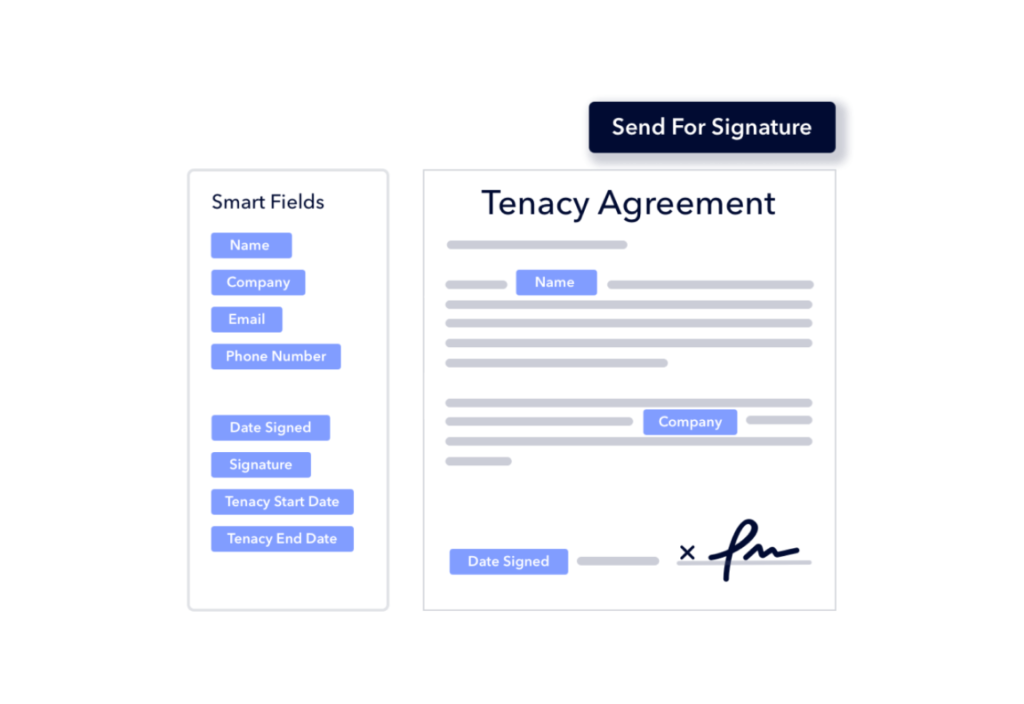
Leasey.AI provides a smart document builder that auto-fills your essential leasing documents in seconds, using custom smart fields placed throughout your templates.
The technology eliminates repetitive copy-paste work, reduces typos and missed fields, and ensures consistency across all documents. Modern property managers use these tools to transform time-consuming paperwork into streamlined digital workflows.
Six Smart Document Types Every Rental Property Needs
A smart rental document uses custom fields placed throughout a template so the document builder can pull verified applicant data and populate every field automatically — replacing the manual copy-paste process that produces typos, missed fields, and inconsistent records. Property managers evaluating smart documents for rental property management benefit most when smart documents cover the full tenant lifecycle rather than just the primary lease. The six document types below form a connected system, where data captured at the application stage flows into each subsequent document without requiring re-entry.
Six Essential Smart Document Types for Rental Management
- Digital Rental Application — A structured online form that captures tenant identity, employment history, and rental references, and immediately triggers credit and background check pipelines upon submission.
- E-Signed Lease Agreement — A legally binding contract generated from applicant data already in the system, delivered for remote digital signature and stored in the cloud for ongoing reference and dispute defense.
- Lease Addendum — A supplementary document added to the primary lease to formalize mid-tenancy policy changes such as pet permissions, parking assignments, or storage allocations, using the same smart field structure as the original lease.
- Move-In / Move-Out Inspection Report — A mobile-friendly document that embeds photos alongside condition notes for each room and fixture, creating a timestamped record that both landlord and tenant sign at the start and end of the tenancy.
- Automated Rent Ledger — A running digital record of every rent transaction, capturing payment date, payment method, amount received, and any late fees applied, providing an auditable cash flow history for each tenancy.
- Notice to Vacate / Eviction Notice — A standardized, timestamped digital document that initiates the formal end of a tenancy or legal proceedings, formatted to meet local notice period requirements so the notice holds up if challenged.
How Inspection Reports and Rent Ledgers Protect Landlord Interests
Move-in inspection reports with embedded photo documentation establish an objective, signed record of property condition before the tenant takes possession — eliminating the "he said, she said" disputes that arise when landlords rely on written descriptions alone. Automated rent ledgers record payment dates, payment methods, and late fees in a single searchable location, giving landlords an auditable cash flow history without manual spreadsheet maintenance. Property managers overseeing multiple units gain the most from automated rent ledgers because ledger accuracy directly affects the financial records landlords need at tax time and during lease renewal negotiations.
Lease Addendums and Notices as Living Document Components
Lease addendums extend the original lease agreement without requiring landlords to draft an entirely new contract — a property manager can add a pet policy addendum or a parking agreement mid-tenancy by generating a smart addendum that pulls the existing tenant and property data automatically. Notices to vacate must comply with local, provincial, or federal notice period requirements to remain legally enforceable, and generating a notice to vacate through a smart document builder reduces the risk that a landlord will omit a required field or miscalculate a notice deadline. Landlords who treat addendums and notices as secondary documents rather than core smart document types leave a consistency gap at precisely the moments — mid-tenancy disputes, tenancy terminations — when document accuracy matters most.
Smart Document Automation Eliminates Manual Data Re-Entry
Property managers searching for smart documents for rental property management typically discover that the largest time cost in leasing is not document signing — it is re-entering the same tenant data across the application, the lease, the addendum, and the inspection report. Leasey.AI's smart document builder auto-fills leasing documents in seconds using smart fields placed throughout templates, removing repetitive data entry from the document generation process entirely. Platforms that automate over 90% of leasing team tasks — as Leasey.AI does — achieve that automation rate specifically because document generation draws from a single verified data source rather than requiring agents to copy data between disconnected tools.
The Four-Stage Document Generation Sequence
Smart document automation works across four sequential stages, and the data quality at each stage determines the accuracy of every document that follows. The sequence begins at the application stage, where the digital rental application captures the tenant's identity, employment, income, and rental history in a structured format the platform can read. Verified applicant data then passes directly into the document builder at Stage 3, so the lease agreement, addendum, and inspection report all draw from the same confirmed record rather than from manually re-keyed copies.
Stages in the Smart Document Generation Workflow
- Data Capture — The digital rental application collects tenant identity, employment details, and rental history in structured fields the platform stores and references downstream.
- Data Verification — The screening stage validates the applicant's credit history, income documents, and identification against trusted third-party sources, producing a verified profile the document builder can rely on.
- Document Generation — The smart document builder pulls verified applicant data into every smart field placed throughout the lease, addendum, and inspection report templates — generating completed documents in seconds.
- E-Signature Collection — The completed documents go to the tenant for digital signature, producing a legally binding executed record that the platform stores in the cloud with a timestamp and signer identification log.
Consistency Across Agents and Portfolio Scale
Smart fields enforce the same data structure and field population rules across every document regardless of which leasing agent generates the document — eliminating the agent-level variation that causes inconsistent lease quality in manual workflows. Leasey.AI's configuration suits both small independent operations and institutional clients managing thousands of properties, with implementations completing in under one week including user training. Property management companies scaling from a handful of units to hundreds gain the most from this consistency guarantee, because document quality does not degrade as portfolio size grows and agent headcount increases.
Smart Documents Reduce Compliance Gaps and Fraud Exposure
Rental documents with missing required disclosures or inaccurate notice periods expose landlords to legal challenges that can invalidate a notice to vacate, delay an eviction, or create liability in a tenancy tribunal hearing. Smart documents address compliance gaps by making required fields mandatory — a document builder can prevent a landlord from generating a notice to vacate without completing the legally required fields — so compliance becomes a structural feature of the document rather than a task the landlord must remember independently. Property managers who rely on manually edited PDF templates carry a higher compliance risk because template updates require the landlord to find, revise, and redistribute every affected document version across the portfolio.
Fraud Detection in Digital Rental Applications
One in four rental applications contains an element of fraud — a rate that makes AI-powered document verification a functional necessity for property managers who cannot afford to place unqualified tenants. Leasey.AI's integration with Discrepancy AI brings document screening and validation technology directly into the application review process, where Discrepancy AI detects anomalies and alterations in income documents such as modified pay stubs or falsified employment letters before a landlord reaches the lease generation stage. The downstream cost of placing a fraudulent applicant is substantial: Ontario's Landlord and Tenant Board currently carries over 53,000 backlogged applications, meaning landlords who place an unqualified tenant face resolution timelines measured in months rather than weeks.
Audit Trails and Document Version History
Digital smart documents generate an audit trail automatically — every document carries a timestamp, a signer identification record, and a version history that establishes what each party agreed to and when. E-signed lease agreements stored in the cloud remain accessible and tamper-evident, so a landlord can retrieve and present the executed document in a dispute without relying on a paper copy that could be lost, altered, or disputed. Landlords managing larger portfolios gain additional protection from version history logs because the logs confirm which template version the document used at the time of signing — a detail that matters when a landlord updates a template mid-year and needs to demonstrate that a specific tenancy used a disclosure-compliant version.
Five Criteria to Evaluate Any Smart Document Platform
Smart document platforms vary significantly in which document types the platform covers and whether document automation extends beyond the primary lease to addendums, inspection reports, and notices — so property managers evaluating platforms benefit from a consistent set of criteria applied across every option. Comprehensive platforms with full document lifecycle coverage typically cost between $50 and $300 per month, while basic tools covering only lease templates are available at no cost. Implementations on capable platforms take under one week including user training, which means the switching cost from a manual process is lower than most property managers expect when first evaluating smart document tools.
Five Criteria for Smart Document Platform Evaluation
- Auto-Fill from Upstream Data — The platform must pull applicant data directly from the screening or application record, not require agents to copy data into document fields manually. Evaluate whether auto-fill covers all six core document types or only the primary lease.
- E-Signature Legal Compliance — The e-signature method must comply with applicable electronic signature legislation in the landlord's jurisdiction — in Canada, the Uniform Electronic Commerce Act provides the federal framework, while US landlords reference applicable state law. Confirm the platform logs signer identification and timestamp for every executed document.
- Template Flexibility Across Document Types — The platform must allow smart field placement in addendum, inspection report, and notice templates — not only in the primary lease. Platforms that restrict smart fields to a single document type leave the remaining documents as manual tasks.
- Integration Depth with Screening Workflow — The platform must connect document generation to the upstream tenant screening data so that verified applicant information flows directly into templates without a manual transfer step between systems.
- Audit Trail and Version History — Every generated document must carry a timestamp, signer identification record, and version history. Confirm the platform stores documents in a tamper-evident format and provides retrieval access without requiring export to a separate storage system.
Template Flexibility Affects Addendum and Notice Coverage
Platforms that limit smart field capability to the primary lease template leave lease addendums and notices to vacate as manually edited documents — creating a consistency gap at the exact stages of the tenancy where documentation accuracy is most likely to be tested. A pet policy addendum or a parking agreement added mid-tenancy requires the same verified tenant and property data as the original lease, and a smart addendum template pulls that data automatically rather than requiring the property manager to locate and re-enter the information. Notices to vacate that miss a required field or use the wrong notice period because of a manual drafting error can be challenged by the tenant, forcing the landlord to restart the notice process and extend the timeline before formal proceedings can begin.
Integration Depth as a Workflow Efficiency Multiplier
Integration between document generation and upstream screening data is the single attribute that determines whether a smart document platform eliminates manual re-entry across the full leasing workflow or only at one stage of the process. Leasey.AI replaced the patchwork of disconnected tools — separate e-signature services, spreadsheet tracking, and manual document drafting — with a single integrated flow where applicant data captured at the rental application stage populates every downstream document without a separate transfer step. Property managers who evaluate platforms on auto-fill capability alone, without checking integration depth, often find that the platform auto-fills the primary lease but still requires manual data entry for addendums, inspection reports, and rent ledger setup — recreating the re-entry problem the platform was selected to solve.